




As some might already know, I consider myself more introverted. I display more extroverted traits depending on who I am surrounded by and how comfortable I feel. Also, I took a "personal profile" questionnaire a few months ago and it concluded I am introverted. I think I first discovered my personality type maybe 5 to 8 years ago. And I'm proud to be an introvert! That's the personality God gave me and I can only but embrace it. I don't see why the word "introvert" is OR should be stigmatized. It's unbelievable how many times I have noticed people that view being "introverted" or "quiet" as a bad thing.
I have had a lot of different assumptions thrown at me in regards to my personality but hey, it's not my fault. I didn't understand why (until recently) and they didn't either. I have a much better understanding of those assumptions than 7 years ago. It's merely a misunderstanding of personality types. And most of those assumptions were from extroverts.
The American society is very extrovert-centric (maybe the whole world is?). I see it at workplaces, on TV, school, church, and just about every social gathering big or small with any ethnicity including my own. People are typically drawn to extroverts over introverts. If I don't appear to be socializing/engaging enough, most times one of these questions comes up, "Are you ok?" "Why are you not talking?" "Why are you so quiet?" "Are you having fun?" "Are you not having fun?" As if it's a bad thing to be silent. It is expected that you are constantly "sociable" even if all you do is small talk. You are easily "accepted" and "approachable." In my observations of people, most don't seem to understand the differences between extroverts and introverts and how to relate to introverts.
These are some questions I have pondered about:
Why are you automatically considered as "rude" because you don't greet someone walking right past you? I have seen people who generally don't greet or smile when you walk right by them (in the workplace) whether they know you or they don't. Some I know are more introverted so I am not surprised at all. But I won't consider everyone who does this as rude. As an introvert myself, the only reason I might not greet (first) is because you are a stranger to me even if I see you all the time. I do make eye contact though. I've noticed some people don't in order to avoid saying hello. I can't speak for all introverts, but my guess is it's just not their personality or they might be shy. For me, I might say hi first or I might not. From a young age, I would wait for people to speak to me before I speak first. If you don't speak to me, I won't speak to you unless there is a good reason to. It has taken a long time to break out of that but I still tend to do that till this very day.
Why do some introverts pretend to be more extroverted? I can understand why for some scenarios (e.g. interviews, teaching kids) but even still it takes too much energy and thinking to pretend. At least for me. My brain isn't wired for continuous energy, dominance, and being gregarious at all times. I'm typically quiet in social gatherings and sometimes I'm fine with being quiet. But of course, not everyone likes that. Besides certain scenarios mentioned earlier, the only reason I think of is the fear of not fitting in. I've never had that fear but I understand it.
The following are several excerpts from the book that I would like to share:
-
Common beliefs in society based on several studies:
- The "extrovert" ideal is that the ideal self is gregarious, alpha, and comfortable in the spotlight. (I am definitely none of those for a fact)
- Talkative people are rated smarter, better-looking, more interesting, and more desirable as friends. We rank fast talkers as more competent and likable than slow ones.
- The majority of teachers believe the ideal student is an extrovert. (I've been there and didn't realize that it was the main problem)
- There are 4 quadrants of personality types: calm introverts, anxious introverts, calm extroverts, anxious/impulsive extroverts. Carl Jung said, "there is no pure introvert or pure extrovert" and I concur.
- General differences between an introvert and an extrovert:
- They focus on the meaning they make of the events swirling around them (extroverts plunge into the events themselves)
- They recharge by being alone (extroverts need to recharge when they don't socialize enough)
- They require less stimulation, for instance reading a book, solving a crossword puzzle (extroverts require outside stimulation like meeting new people, cranking up the stereo)
- They work more slowly and deliberately, focus on one task at a time, and can have high levels of concentration (extroverts tend to tackle assignments quickly, make fast/rash decisions, multi-task, and take risks)
- They are relatively immune to lures of wealth and fame
- They listen more than they talk (extroverts prefer talking to listening and occasionally blurt out things they never meant to say)
- They prefer to devote their social energies to close friends, colleagues, and family
- They tend to dislike conflict (extroverts are comfortable with conflict)
- They often feel as if they express themselves better in writing than in conversation
- Many have a horror of small talk, but enjoy deep discussions
- Most are friendly
- Not all are necessarily shy
- Many are highly sensitive, e.g. feeling overwhelmed by an act of extraordinary kindness, very strong conscience
- In the 1920s, psychologists, social workers, and doctors focused on the everyday child with a maladjusted personality (shy children). They believed "shyness could lead to dire outcomes, they warned, from alcoholism to suicide, while an outgoing personality would bring social and financial success". The experts advised parents to socialize their children well and schools to change their emphasis from book-learning to assisting and guiding the developing personality. (Isn't this a load of bullshit?)
- In the 1950s, the slogan "a healthy personality for every child" was promoted by the Mid-Century White House Conference on Children and Youth.
- Introverted children were often singled out as problem cases.
- Harvard’s provost Paul Buck declared in the late 1940s that Harvard should reject the “sensitive, neurotic” type and the “intellectually over-stimulated” in favor of boys of the “healthy extrovert kind.” In 1950, Yale’s president, Alfred Whitney Griswold, declared that the ideal Yalie was not a “beetle-browed, highly specialized intellectual, but a well-rounded man.” Another dean told Whyte that “in screening applications from secondary schools he felt it was only common sense to take into account not only what the college wanted, but what, four years later, corporations’ recruiters would want. ‘They like a pretty gregarious, active type,’ he said. So we find that the best man is the one who’s had an 80 or 85 average in school and plenty of extracurricular activity. We see little use for the “brilliant” introvert.
- In 1955, a drug company named Carter-Wallace released the anti-anxiety drug Miltown, reframing anxiety as the natural product of a society that was both dog-eat-dog and relentlessly social.
- The 1960s tranquilizer Serentil followed with an ad campaign even more direct in its appeal to improve social performance. “FOR THE ANXIETY THAT COMES FROM NOT FITTING IN,” it empathized. (Like what da…..???!!!)
Examples of famous introverts: Barack Obama, Rosa Parks, Warren Buffett, Al Gore, Bill Gates, Author of Harry Potter, Eleanor Roosevelt, Gandhi, Hilary Clinton
Examples of famous extroverts: Bill Clinton, Oprah Winfrey, George W. Bush, Muhammad Ali, Margaret Thatcher
Questions to readers:
- Do you know your personality type?
- If you are more extroverted, what is one thing you never knew or understood about introverts?

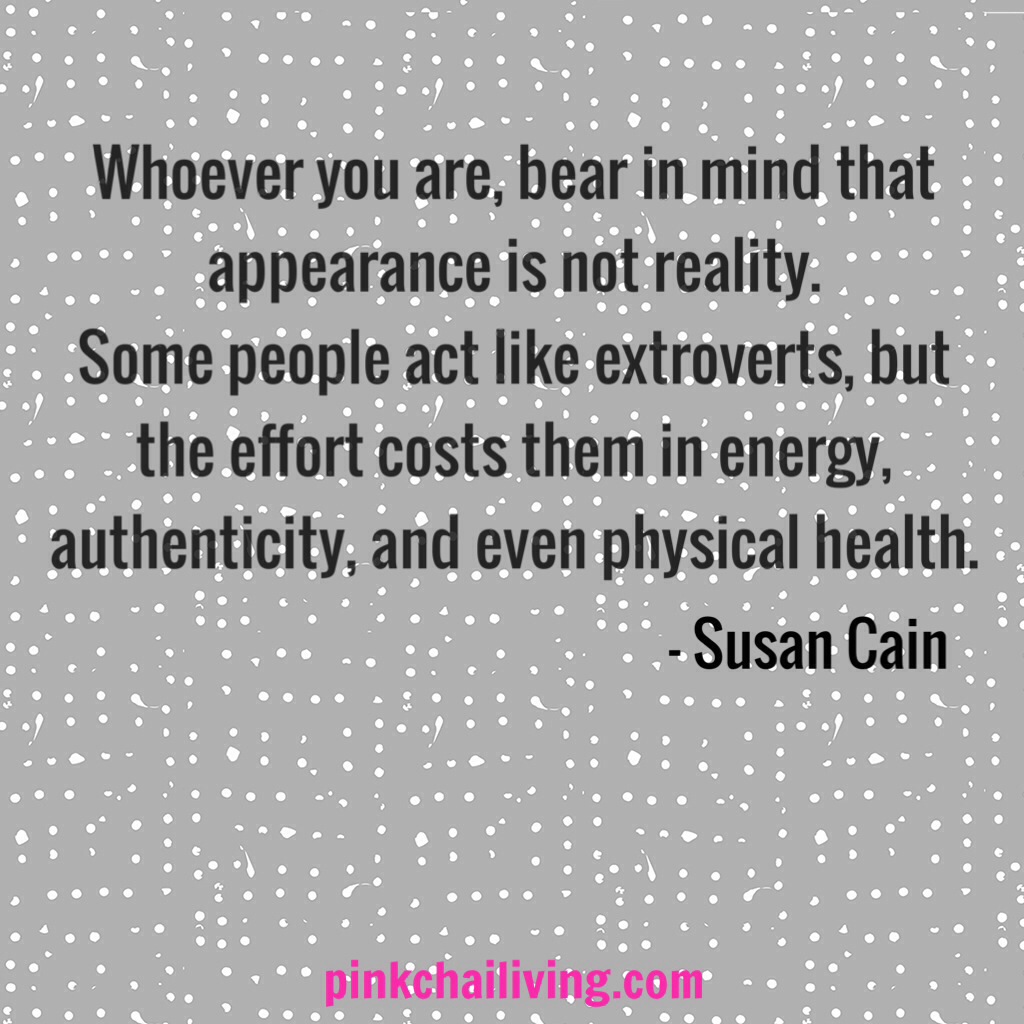


Oh, Anna, I could hug you! This describes me exactly! I've dealt with people making assumptions about me my whole life because I'm an introvert, and it's nice to be finally understood. I just wish I could go back and tell my younger self that I'm not a freak! To be honest, I have pretended to be an extrovert at social events and job interviews, but it was exhausting and I felt totally fake. It annoys me that being "bubbly and outgoing" is the "ideal" personality type, you just have to look at job vacancy ads, and that's what they want, and I'm like WHY? Anyway, I must get myself a copy of this book.
ReplyDeleteBeautifully written, Anna, I wouldn't change a single word :)
♥.•*¨ Amanda Says ¨*•.♥
Lol *hugs*! Thanks!!! I've been called a freak in middle school too but somehow I didn't let it bother me. I never did fit in school or anywhere. Never bothered to put in the effort although I desired company/friends. I really didn't know how to. Might explain why I was unable to play the "extrovert" role. I never picked up on the whole "extrovert" ideal until a few years ago. It also explains why I hate job interviews with a passion and sucked at them. Only prayer and research has helped me get through interviews otherwise I don't think I could get hired.
DeleteAnyways, yes, get yourself a copy of this book! God bless Susan Cain! I want to meet her!